

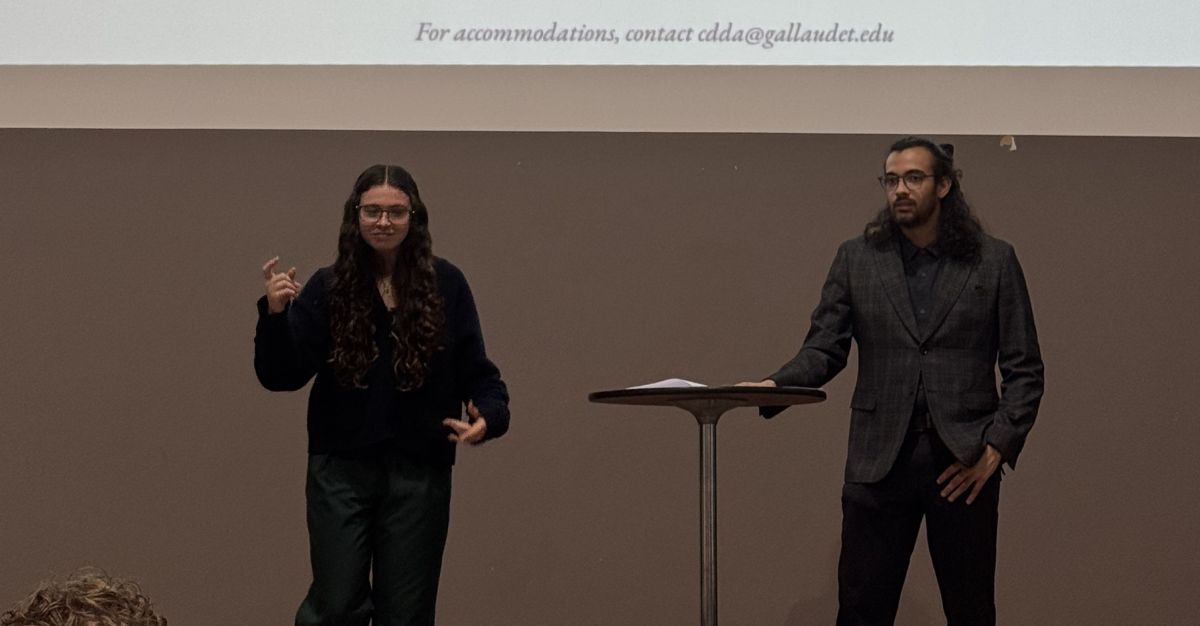
The Veditz Debate on March 5 focused on a complex and sensitive question: “Is the public’s obsession with the Epstein files doing more harm than good?”
Debaters Clark Barrett and Sydney Block took the stage, with Trent Mora and Dalina Schwartz moderating.
The moderators made one thing clear from the start – this debate was not about Epstein himself, but about the public reaction to the release of the files. The focus was on impact: individuals, communities, and society as a whole.
They also emphasized what makes Veditz debates unique:
- Interactive format
- Audience participation encouraged
- Focus on storytelling and perspectives, not just facts
- Open dialogue in ASL
Before the debate began, the audience poll showed: - Yes (more good than harm): 39%
- No (more harm than good): 61%
Opening Statements
Sydney Block (In Favor) argued that public obsession can actually be productive. She shared a personal example of discussing the files with friends, where curiosity led to questioning sources
and checking facts.
Her main point: curiosity drives media literacy and accountability. When people stay engaged, they are more likely to question information, seek truth, and hold powerful individuals responsible.
She emphasized that without public attention, accountability may disappear.
Clark Barrett (Not in Favor) took a different approach, focusing on due process.
He warned that obsession can lead to:
- Misinterpretation of information
- Public judgment without evidence
- Harm to innocent people named in the files
- He pointed out that the files include thousands of names, not all of whom are guilty.
- Releasing information without proper context can expose victims and innocent individuals, creating damage before the legal system has a chance to work.
- His core argument: justice requires process, not public pressure.
Audience Perspectives
The open floor brought a wide range of opinions:
- Some argued that obsession increases transparency and awareness, especially around
issues like human trafficking. - Others pushed back, saying the real problem is failure of the justice system, not public
attention. - Several speakers said obsession can spark important conversations and even unify people.
- Others warned that it can turn into misinformation, conspiracy thinking, and emotional
reactions without facts.
One speaker made a strong distinction between passion and obsession, arguing:
- Passion = thoughtful, fact-based engagement
- Obsession = emotional, sensational, and often misleading
Another emphasized that without strong public attention, many injustices – past and present – would never have been exposed.
There were also concerns about:
- Mental health impacts of constant exposure
- The risk of false accusations
- The danger of replacing due process with public judgment
Across both sides, a few major themes stood out:
- Accountability vs. Due Process
- Curiosity vs. Misinformation
- Passion vs. Obsession
- Public Power vs. System Failure
Closing Arguments
Sydney (In Favor) argued that public obsession strengthens democracy. She acknowledged short-term downsides like anxiety or misinformation, but argued that long-term benefits – awareness, accountability, and engagement – outweigh the risks. She also challenged trust in existing systems, suggesting that without public pressure, meaningful change may not happen.
Clark (Not in Favor) agreed that accountability is necessary, but stressed that how we get there matters. He warned that obsession can turn into “digital voyeurism”, where people focus more on speculation than justice. His closing point was clear: Obsession might expose wrongdoing – but it can also harm innocent people and weaken the justice process.
Final Results
After the debate, the audience vote shifted significantly:
- Yes (more good than harm): 75%
- No (more harm than good): 25%
The final decision: Winner (audience + judges): Sydney Block
The debate ended with a reminder of the importance of open dialogue, especially on difficult topics.
The next Veditz Debate will take place on April 9, with the topic:
“The American Deaf community is in decline.”