

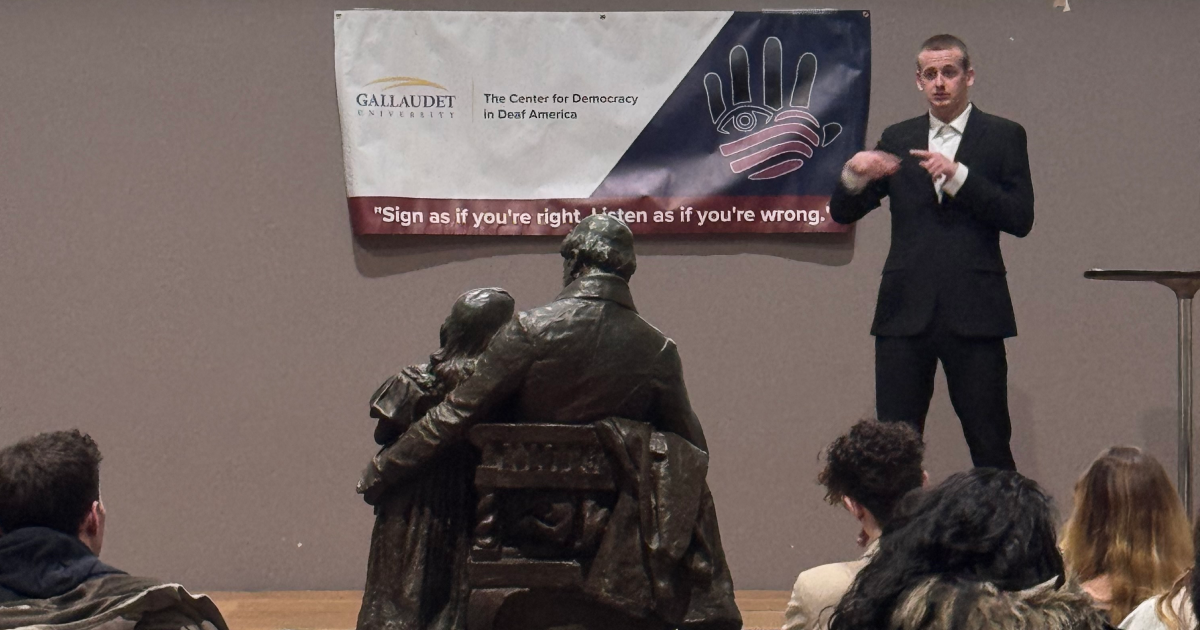
The Gallaudet Debate Team hosted a Veditz Debate focused on one of the most contested aspects of campus life: “Should Greek life be abolished at Gallaudet?” Sponsored by Center for Democracy in Deaf America (CDDA) and Student Body Government and supported by COM 490, the event followed the Veditz model – active audience participation, live reactions, and questions permitted throughout the debate.
The evening opened with a debate song performed by Ella Stromberg and Syd Block, setting an energetic tone before moderators Clark and Nicole introduced the motion and outlined the rules. Audience members were reminded not to record personal videos or photos, as official documentation was being handled by the Communication Department, and to avoid assuming that speakers personally agreed with the positions they were assigned.
A pre-debate poll showed the audience leaning against abolition:
- Yes: 41%
- No: 59%
Opening Arguments
Pax Holcomb opened on the pro-abolition side, acknowledging personal relationships with members of Greek life and expressing hope that those relationships would remain intact after the debate. Holcomb quoted Abraham Lincoln, arguing that sometimes a limb must be removed to save the body. He asserted that Greek life has damaged Gallaudet’s reputation, citing controversy, elitism through selective membership, and the broader impact on public perception and institutional support. While recognizing that Greek life offers bonding and community, Holcomb argued those benefits could exist elsewhere without the associated harm.
Trent Mora, arguing against abolition, emphasized that the motion was not about reform but total elimination. He argued that to justify abolition, opponents must prove that harm comes directly from Greek life itself and that removal would meaningfully improve Gallaudet. Mora pointed to reform programs already in place and described secrecy within Greek life as comparable to confidentiality in therapy – something that can be protective rather than harmful. He highlighted Greek life’s long-standing contributions to the Deaf community and urged the audience to preserve and improve, rather than abolish, the system.
Floor Speeches
Jevon Burns spoke about the idea of Gallaudet as a home. He argued that secrecy within Greek life undermines that sense of home, asking why there should be secrets in a community meant to feel safe and inclusive. Burns distinguished between making mistakes and causing harm, stating that Greek life has crossed into harmful behavior rather than isolated errors.
Donovan Holmes challenged Pax Holcomb’s claim that Congress closely monitors Greek life at Gallaudet. Holmes argued that faith in congressional oversight is overstated and warned that abolishing Greek life could actually risk losing government support rather than gaining it.
Francis questioned the effectiveness of the debate itself, pointing out that many audience members were already affiliated with Greek life. He argued that without a more diverse and representative audience, the debate and vote were limited in their ability to drive real progress.
Vanessa Waldhof emphasized that strong bonds exist in many student organizations, not just Greek life. She addressed complaints about rejection from Greek organizations by noting that selection criteria exist across campus groups. Waldhof stressed that all organizations – including Greek life – require reform and improvement, not elimination. She also cited the imbalance in numbers, questioning why the interests of one-sixth of the student population should be abolished to satisfy the remaining five-sixths.
Treean Bonn reframed the issue through the lens of healing justice rather than social justice. Bonn argued that Greek life needs healing, and emphasized the importance of addressing pain while still striving to connect people from different backgrounds within the Deaf community.
Noor focused on the future of Greek life, pointing to its evolution and improvements over time. Noor argued that Gallaudet would not feel the same without Greek life and noted that modern Greek organizations are more positive and accountable than in the past. He also referenced Greek life’s involvement in supporting DPN protests and questioned why Deaf Greek life is targeted when hearing universities often have worse records.
John Scarboro raised concerns about trust in the administration, referencing demonstrations related to Student Engagement and Leadership (SEL). Scarboro argued that if the same administrative structures responsible for past issues are tasked with reform, meaningful change may not occur. If the administration cannot be trusted to enforce reforms, Scarboro concluded, abolition becomes the only viable option.
Richie Bryant responded to claims that Greek life leaders were instrumental in DPN activism, acknowledging that many leaders were involved but also sharing personal observations of exclusion and rejection across fraternities. Bryant stated that such behavior is unacceptable and undermines claims of unity.
Hadassah introduced an external example, referencing a 2020 hazing-related death at another university that led the Louisiana officials to suspend Greek life for a year. She used this case to highlight the real-world risks associated with hazing.
Elizabeth Peterson pushed back against comparisons to hearing universities, arguing that those contexts are not directly relevant to a Deaf institution. She emphasized that many beloved campus events are hosted by Greek organizations and noted that many successful alumni were involved in Greek life. Peterson warned that abolishing Greek life would also mean losing long-standing traditions and events cherished by students.
Ethan Jacobs addressed the dangers of confidentiality, citing a tragic case at a hearing university where secrecy contributed to a death. Jacobs argued that secrecy, when misused, can prevent accountability and enable harm.
Dalina Schwartz acknowledged concerns about secrecy but argued that Gallaudet has accountability measures in place to address hazing and misconduct. She emphasized that Greek life instills values of service and leadership and contributes significantly to the Deaf community. While other organizations can offer leadership development, Schwartz argued that Greek life’s impact is deeper and more sustained.
Ella Stromberg shared a personal story involving a close friend who joined a sorority and disappeared for 24 hours. When the friend returned, she described being forcibly taken, blindfolded, and subjected to exhausting tasks – an experience that ultimately led her to resign. Stromberg stressed that the absence of widespread incidents does not mean harm cannot or will not happen.
Zefan Nathanson argued against abolition, stating that accountability rests with members of Greek life themselves. Nathanson emphasized that current bylaws and safeguards are far stronger than in the past and that secrecy can be part of what attracts members. Greek life, he said, is intended to foster growth and success while ensuring future generations do not experience past harms.
Closing Arguments
In his closing, Pax Holcomb argued that problems tied to Greek life ultimately affect the university as a whole, drawing in external scrutiny and damaging reputation. He stated that students will attend Gallaudet without Greek life – and that some avoid the university because of it. Leadership, he argued, exists independently of Greek life. Abolishing Greek life, while difficult, was framed as a necessary step toward improving enrollment, equity, and well-being.
Trent Mora closed by thanking participants for meaningful engagement. He revisited the limb analogy, arguing that removing Greek life entirely could cause more harm than good. Mora asserted that abolishing Greek life would not dismantle racism or systemic issues and emphasized the importance of multiple identities within the Deaf community. He concluded that the potential of Greek life is far from exhausted and that abolition would be an extreme response.
Post-Debate Results
The post-debate poll revealed a significant shift:
- Yes: 29%
- No: 71%
A 12% swing toward keeping Greek life underscored the impact of the discussion.
As with many Veditz Debates, the night did not deliver easy answers – but it did exactly what it was meant to do: challenge assumptions, amplify student voices, and push the campus conversation forward.